A Quiet Observation Walk Through a Casino Venue
A quiet observation walk through a casino venue helps you read public design and social rituals without tracking guests or mistaking open space for permission.
The common mistake on a quiet observation walk through a casino venue is to watch the gaming floor for activity. That can turn other people into the subject and make a social space feel like a spectacle. In Vĩnh Long, keep your attention on the public setting: the places where people gather, pause, and move through the venue.
Check access rules before you begin. Stay in areas clearly open to visitors, follow posted directions, and ask staff when a boundary is unclear. The point is to understand how a place supports shared use, not to follow anyone’s visit.
A quiet observation walk reads the room, not its guests
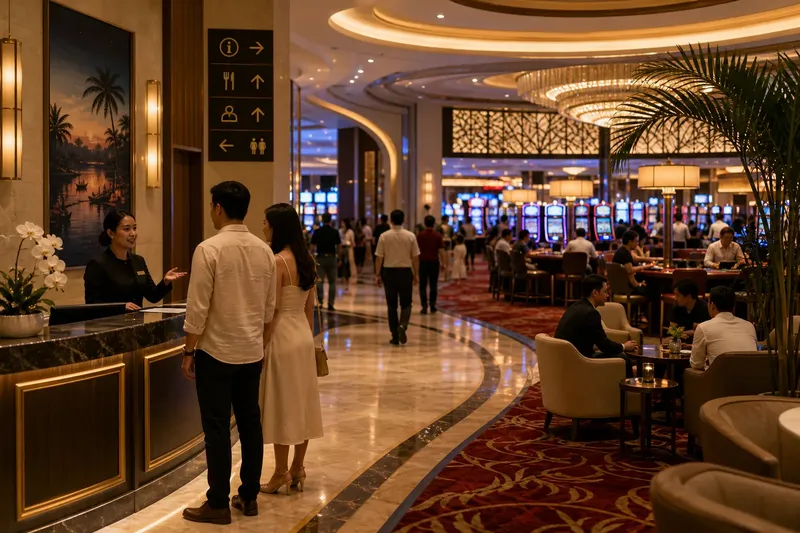
Start at a public entrance or reception area. Notice the directory, visible service counters, public seating, and routes toward places such as a café or lounge. These features show what the venue makes easy to find without requiring you to track anyone’s movements.
Pay attention to transitions. A change in lighting, flooring, or furniture may signal a shift from a passage to a place intended for lingering. Note the order of spaces and the cues that distinguish them; do not guess why a particular visitor chooses one route over another.
Furniture suggests social uses without explaining them
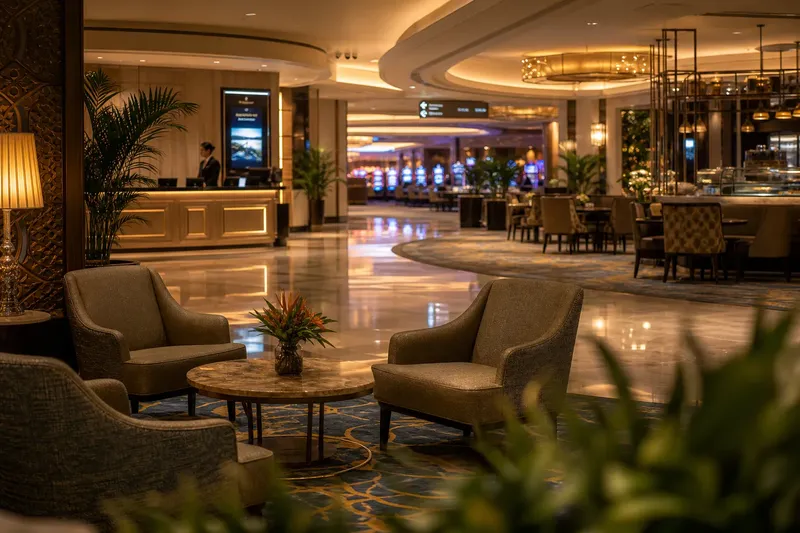
Seats arranged toward one another can support conversation. A bench near reception may accommodate a short wait, while tables near a dining counter offer a different setting for a pause. These are observations about the arrangement, not claims about the people who use it.
Notice the paths between furniture and doorways, too. An open route may make it easier to enter and leave; a crowded arrangement may offer little room to stop. Follow signs about reserved or restricted areas rather than treating an appealing layout as an invitation.
Field notes should separate what is visible from what is assumed
Write down a public location, a feature you can see, and the choice that feature appears to allow. For instance: “Lounge beside reception; chairs face one another; passage to the entrance stays clear.” Leave out names, faces, conversations, and guesses about relationships or plans.
- Seating arrangement: If chairs face one another and the walkway remains open, note that the layout allows conversation; if the chairs block the route, observe from another public spot.
- Waiting area: If seats are near reception or a service counter, note their location; if a line occupies the area, move away rather than adding to congestion.
- Resting space: If seating is set apart from the main passage, note that it offers a pause away from through-traffic; if it is marked private or reserved, choose a public seating area instead.
- Dining area: If a café is clearly open to visitors, note its entrance and posted guidance; if access is unclear, ask staff before approaching.
- Shared table: If seats are grouped around a table, record the arrangement without listening in; if conversation carries, give the group more space or continue walking.
- Route to seating: If signs clearly lead to public seats, follow them; if a doorway or passage is ambiguous, ask an employee rather than guessing.
How can you keep an observation walk respectful?
Can I visit without gambling?
Access depends on the venue’s rules and on which spaces are open to visitors. Check posted notices and ask staff if you are unsure; an open-looking doorway is not permission to enter.
What belongs in field notes?
Record public features such as signs, furniture, routes, and transitions between areas. Leave out names, faces, conversation details, and guesses about guests’ plans.
Should I take photographs?
Do not photograph or record people as part of an observation walk. If you want to document a space, check the venue’s rules and ask staff first; if permission is uncertain, use brief written notes after leaving the area.
What if public access is unclear?
Ask an employee before entering. If you cannot get a clear answer, remain in an area plainly open to visitors.
A worked walk follows the layout, not the guests
Imagine you arrive at a public entrance with one question: where can a visitor sit away from the main flow? You read the directory and see “lounge,” then ask a staff member which route is open to visitors. Following the indicated passage, you find chairs set away from the main route and a clear path back to reception. Your note records the lounge’s location, the seating, and the route back; the practical decision is that this is a public place to pause, provided the posted guidance remains consistent. No guest needs to become part of the record.
Counting visitors, mapping every table, or trying to hear conversations is not worth the effort. A quiet observation walk through a casino venue is more useful when it records how the space supports social rituals and leaves the people using it unobserved.