How to Read the Social Spaces of a Casino Visit in Vĩnh Long
Understand the social spaces of a casino visit in Vĩnh Long, from the entrance to shared rooms, so you can choose where to spend time without feeling rushed.
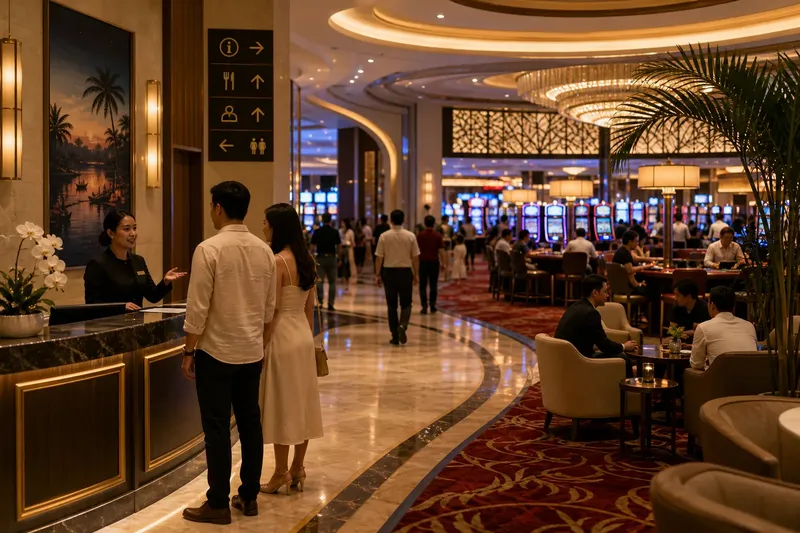
The common mistake on a casino visit in Vĩnh Long is treating the venue as a single room with one obvious purpose. That can make a visitor miss the quieter places to pause, ask a question, or simply wait for a companion. Read the layout as a set of social spaces, each with its own cues.
Local venues differ, and a property’s signs and staff are the best sources for current details. Rather than assume every space is available or arranged the same way, notice where people gather, where they pass through, and where the venue directs guests for assistance.
The entrance sets the tone for the visit
At the entrance, pause long enough to orient yourself. Look for the reception or information point, signs about access, and directions to public areas. If you arrive with someone else, agree on a place to meet again before you separate; a clearly marked lobby or information desk is easier to describe than a particular machine or table.
This brief orientation is not a search for every rule or amenity. It is a way to know where to ask for help and how to return to the main route. If signage is unclear, ask an employee rather than wandering into a restricted area.
Shared areas have different social expectations
A gaming floor, lounge, dining area, and corridor each invite a different kind of presence. On a gaming floor, people may be concentrating on an activity and prefer not to be interrupted. A lounge or dining area is generally more suited to conversation, though posted rules and staff guidance still apply.
Pay attention to the practical cues: whether people are seated for an activity, waiting in a line, speaking quietly, or moving through. Keep walkways clear, avoid photographing people without permission, and ask before joining a group or taking a seat that may be reserved.
Use the layout to keep a group together
Groups can drift apart when each person follows a different interest. Choose a simple meeting point before splitting up, and agree on how you will reconnect if phones are silent or the venue is noisy. An information desk, a named lounge entrance, or another obvious landmark can work better than a vague instruction to meet “near the games.”
Say you and a companion enter with an invented plan to meet at the information desk after visiting separate areas. You notice that the desk is beside a busy passage, so you ask staff to identify a quieter nearby landmark that remains open to guests. You agree to meet there, and if the landmark becomes crowded, the information desk is the fallback. The useful result is a clear primary place and an alternative, not a promise that either will always be available.
Check the social setting before settling in
- Access: Check whether signs show the area is open to guests; if they do, continue, and if they do not, ask staff or choose a public area.
- Conversation: Notice whether nearby guests are talking or focused on an activity; if conversation seems welcome, speak quietly, and if not, wait or move to a lounge.
- Seating: Check for reserved signs or belongings on a seat; if the place appears available, ask before sitting, and if not, find another seat or ask staff.
- Movement: Notice whether people are using the route to pass through; if the space is a walkway, keep moving, and if you need to pause, step into a designated waiting area.
- Group contact: Check that everyone knows the meeting point and fallback; if they do, separate only as planned, and if not, regroup before going to different areas.
- Privacy: Check whether a photo would include other guests or staff; if it would, put the camera away or ask permission, and if permission is unclear, do not take the photo.
- Assistance: Notice whether directions or venue rules remain unclear; if staff can clarify them, ask, and if uncertainty remains, stay in a public area or leave that part of the venue.
It is not worth mapping every corridor or memorizing the entire floor plan. Knowing the information point, a suitable waiting place, and the route back to the entrance is usually enough for an unhurried visit.
Small social cues can answer practical questions
People’s behavior offers useful context, but it should not replace posted rules or direct guidance. A quiet room may be intended for conversation, rest, or dining; its signage and staff can tell you which. A queue may indicate that guests are waiting for service, so joining at the end is more courteous than approaching the counter from the side.
For anything involving access, guest conduct, or an activity’s rules, ask an employee. If you feel uncomfortable, step into a public area and decide whether to continue. You do not need to explain a change of plans to other guests.
What should you look for in the venue?
Where should you ask for directions?
Look for a reception or information point, or ask an employee in a public area. If the first directions are unclear, ask the person to name a visible landmark along the route.
Where is a good place to wait for a companion?
Choose a clearly identified public area that does not block a doorway, queue, or walkway. Agree on a backup landmark in case the first place becomes busy or unavailable.
How can you tell whether a space is suitable for conversation?
Check signs and observe whether guests are talking or concentrating on an activity. When the cues are mixed, keep your voice low or move to a lounge or dining area and confirm with staff.
What should you do if a space feels uncomfortable?
Move to a public area, find staff, or return to the entrance. If you came with others, use the meeting plan you agreed on rather than searching alone through unfamiliar areas.
Leave with a clear route and a shared plan
Before separating from companions or leaving, confirm the meeting point and the route back to the entrance. If you are arranging transportation, use a designated pickup area and follow the venue’s directions rather than waiting in a traffic lane.
The social spaces of a casino visit in Vĩnh Long are easier to read when you treat signs, staff guidance, and other guests’ use of a room as practical information. A few clear landmarks can make the visit feel more settled without turning it into a tour of every corner.